Jantar Mantar's Removal as a Protest Site Raises Questions About the Future of Public Dissent in Delhi

  • | Monday | 12th October, 2026

BY-Alok Verma 

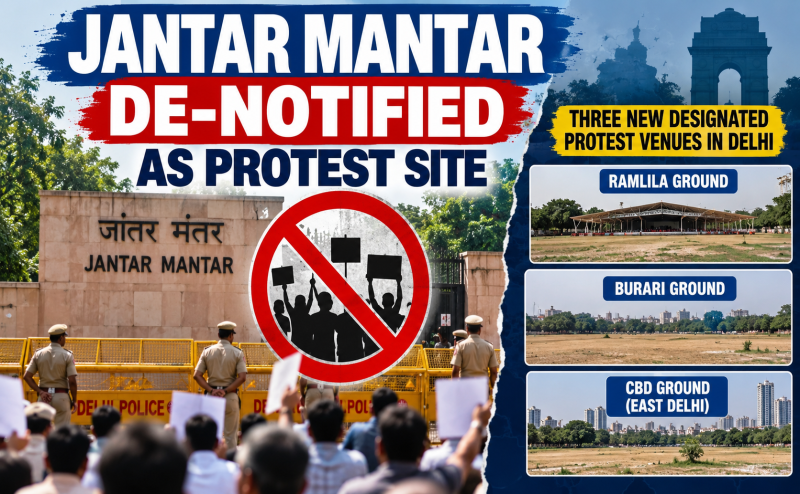
When Delhi Police decided to remove Jantar Mantar from the list of designated protest sites and identify three alternative venues for demonstrations, it brought into focus a question that extends beyond the administration of public spaces. How should a democratic capital balance the legitimate requirements of public order with citizens’ ability to assemble, express grievances and draw attention to issues of public concern? The decision to designate Ramlila Ground, Burari Ground and CBD Ground in East Delhi as alternative venues marks a significant change in Delhi’s established protest landscape. Its wider implications, however, will depend on how the new arrangements are implemented and whether they provide citizens with meaningful opportunities to exercise their right to peaceful assembly.

Jantar Mantar has occupied a distinctive place in India’s democratic life. For decades, it has served as a recognised platform for political movements, trade unions, students, farmers, social activists and citizens seeking to bring their demands to the attention of the government and the wider public. Its significance lies not merely in its physical location but also in the association it has acquired with collective expression. A demonstration held at an established protest venue in the national capital can become part of a national conversation, attracting media attention and bringing issues that might otherwise remain local into the public domain.

The venue’s history illustrates this role. Anna Hazare’s anti-corruption movement in 2011 helped establish Jantar Mantar as a nationally recognised centre of public mobilisation. Over the years, demonstrations concerning employment, social justice, government policy and the demands of various professional and community groups have reinforced its identity as a space for dissent. The 2023 wrestlers’ protest also drew national attention to the venue. These movements differed in their objectives and political circumstances, but they shared a common requirement: a visible public platform through which collective grievances could be communicated.

The removal of Jantar Mantar from the designated list therefore represents more than a change in the location of demonstrations. It raises questions about the relationship between the physical geography of a city and the practical exercise of democratic rights. The right to protest is not determined solely by the formal permission to assemble. Accessibility, public visibility, transportation, proximity to institutions and the ability to reach audiences also influence whether a demonstration can effectively communicate its message.

The three alternative venues identified by Delhi Police—Ramlila Ground, Burari Ground and CBD Ground in East Delhi—will need to be assessed in this context. Each location presents different considerations involving transport connectivity, the availability of public facilities, crowd management and access for participants travelling from different parts of the city. A venue that offers sufficient physical space may serve administrative requirements, but its suitability for public demonstrations also depends on whether participants can reach it conveniently and whether their concerns can receive appropriate public attention.

This distinction is particularly important for smaller organisations and groups representing economically disadvantaged communities. For such groups, organising a demonstration already involves considerable effort, including travel, coordination, financial expenditure and the mobilisation of participants. Changes in venue arrangements can add to these practical demands. The extent of that impact will depend on the facilities available at the alternative locations, the permissions required and the procedures established by the authorities.

At the same time, the administration of public demonstrations in a densely populated capital presents genuine challenges. Large gatherings can affect traffic, public services and the movement of residents. Police authorities have responsibilities relating to public safety, security and the maintenance of public order. Designated venues and clearly defined procedures can help manage these concerns. The central question, therefore, is not whether public order matters, but how administrative arrangements can protect it without unnecessarily restricting peaceful collective expression.

The legal framework provides an important reference point. Article 19(1)(b) of the Constitution guarantees citizens the right to assemble peaceably and without arms, subject to the reasonable restrictions permitted under Article 19(3). This does not confer an unrestricted right to assemble at any location or without complying with applicable laws. Nor does the removal of a particular venue from an official list, by itself, establish that the constitutional right to peaceful assembly has been abolished. The practical effect must be understood in relation to the applicable order, the rules governing demonstrations and the arrangements made for alternative venues.

This makes the revised standard operating procedures announced by Delhi Police particularly important. The procedures will need to clarify how applications for demonstrations are handled, what conditions apply, how security requirements are communicated and how competing requests for the use of public spaces are addressed. Transparency and predictability in these processes can reduce uncertainty for both organisers and the authorities. Clear criteria can also help ensure that decisions are understood as administrative measures rather than arbitrary barriers to participation.

Another important consideration is the relationship between a protest and the audience it seeks to reach. Demonstrations are a form of public communication. Their effectiveness often depends on the visibility of the issue, the presence of participants and the ability of journalists and citizens to observe and report the event. Moving demonstrations to alternative locations may change these dynamics. Whether the new venues provide comparable opportunities for public engagement will become clearer only through their actual use and the experience of groups organising demonstrations there.

The wider debate should consequently move beyond the immediate question of where protests may be held. It should examine whether Delhi’s arrangements offer a workable balance between administrative convenience, public safety and democratic participation. The authorities can help establish that balance by making the revised procedures accessible, explaining the criteria for granting permissions and ensuring that the alternative venues are practically usable. Civil society organisations and protest organisers, in turn, must operate within the applicable legal framework and respect the rights of other citizens.

A democratic capital requires both effective public administration and credible channels through which citizens can question decisions, express dissatisfaction and seek accountability. The two responsibilities need not be treated as opposing objectives. Well-designed protest arrangements can help manage large gatherings while preserving the opportunity for peaceful dissent.

Jantar Mantar’s removal from the list of designated protest sites marks a significant change in Delhi’s established geography of public protest. Whether that change becomes primarily an administrative reorganisation or a broader challenge for access to public expression will depend on the implementation of the new system. The ultimate test will be whether citizens continue to have accessible, transparent and effective avenues to make their voices heard.

(The writer is a senior and national award-winning journalist and founder of Newzstreet Media.)


If You Like This Story, Support NYOOOZ

NYOOOZ SUPPORTER

NYOOOZ FRIEND

Your support to NYOOOZ will help us to continue create and publish news for and from smaller cities, which also need equal voice as much as citizens living in bigger cities have through mainstream media organizations.


Stay updated with all the Delhi Latest News headlines here. For more exclusive & live news updates from all around India, stay connected with NYOOOZ.

Related Articles